
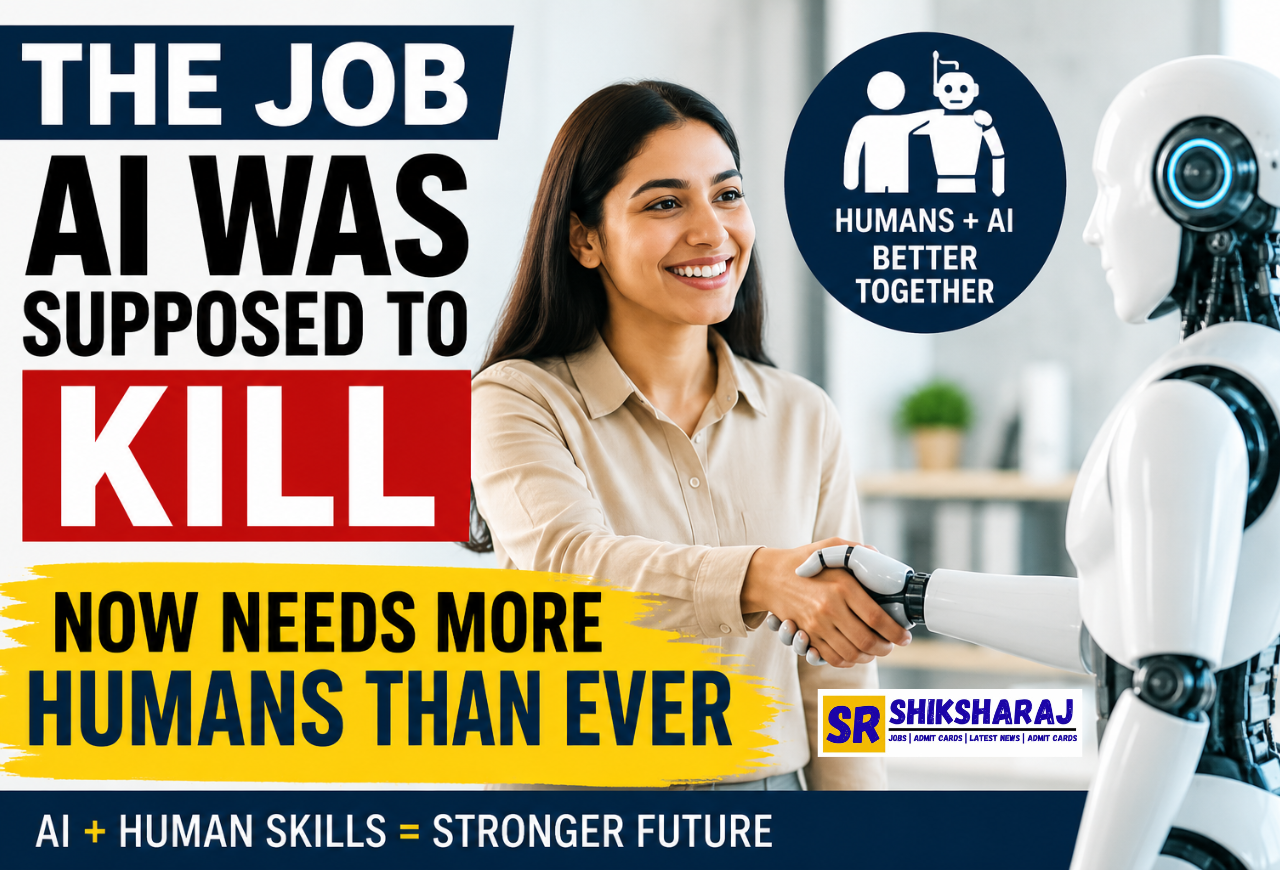
For years, people believed that Artificial Intelligence (AI) would completely replace many office jobs, especially those involving writing, customer support, data processing, and administrative work. Headlines often predicted a future where machines would do everything faster and cheaper than humans. However, a surprising trend has emerged in recent years. Instead of eliminating certain jobs, AI has actually increased the demand for human workers in several industries. Companies are discovering that while AI can automate routine tasks, it still requires skilled people to guide, monitor, improve, and manage its output. As a result, some jobs that were once considered “at risk” are now growing faster than expected.
| Topic | Details |
|---|---|
| Main Trend | AI is creating demand for more human workers in many sectors |
| Most Affected Roles | Content creation, customer support, data analysis, marketing, and software development |
| Why Humans Are Needed | AI requires supervision, verification, creativity, and decision-making |
| Employer Demand | Companies are hiring professionals who can work alongside AI tools |
| Student Opportunity | Learning AI-related skills can improve career prospects |
| Future Outlook | Human-AI collaboration is expected to become the standard workplace model |
Why Predictions About AI Replacing Jobs Were Only Partly Correct
When AI tools became more advanced, many experts expected businesses to reduce their workforce significantly. While automation has replaced some repetitive activities, real-world experience has shown that AI systems often make mistakes, misunderstand context, and produce inaccurate information. Businesses quickly learned that completely removing human involvement can create quality problems, customer dissatisfaction, and operational risks. Instead of replacing workers entirely, organizations began hiring people who could review AI-generated work, correct errors, and ensure that final outputs meet professional standards. This shift has created new employment opportunities rather than eliminating them.
The Rise of Human-AI Collaboration
Modern workplaces are increasingly adopting a model where humans and AI work together. AI handles repetitive and time-consuming tasks, while humans focus on judgment, creativity, communication, and strategic thinking. For example, AI can generate a draft article within minutes, but experienced writers are still needed to verify facts, improve readability, and add valuable insights. Similarly, customer support teams use AI chatbots to answer basic questions, but human agents step in when customers face complex issues. This collaborative approach improves productivity while maintaining quality and customer trust.
Content and Digital Marketing Jobs Are Growing
One of the biggest surprises in the AI era is the continued growth of content-related careers. Many businesses initially believed AI would completely automate content creation. Instead, companies discovered that search engines and readers prefer content that demonstrates expertise, originality, and human understanding. AI can help generate ideas and outlines, but human writers remain essential for storytelling, research, editing, and audience engagement. As a result, employers are actively hiring content writers, editors, SEO specialists, and digital marketers who know how to use AI tools effectively while maintaining high-quality standards.
Customer Service Still Needs Human Understanding
Customer support was another field expected to experience major job losses due to AI chatbots. While automated systems now handle simple inquiries, customers still prefer human interaction when dealing with important problems, financial issues, technical difficulties, or emotional concerns. Businesses have found that empathy, patience, and problem-solving abilities remain difficult for AI to replicate consistently. Consequently, many companies are expanding customer support teams and training employees to work alongside AI-powered systems rather than replacing them completely.
Comparison Of AI Strengths vs Human Strengths
| AI Strengths | Human Strengths |
|---|---|
| Fast data processing | Critical thinking |
| Works 24/7 | Creativity |
| Handles repetitive tasks | Emotional intelligence |
| Generates quick drafts | Ethical decision-making |
| Analyzes large datasets | Context understanding |
| Automates workflows | Relationship building |
Why Employers Are Hiring More People
Many organizations expected AI to reduce costs by replacing workers, but they soon discovered that successful AI implementation requires additional human expertise. Businesses now need AI trainers, prompt specialists, content reviewers, compliance experts, data analysts, and quality assurance professionals. These roles ensure that AI-generated outputs remain accurate, legal, and aligned with company goals. In many cases, AI adoption has increased productivity so significantly that companies are expanding operations and hiring more staff to manage growing workloads and customer demand.
Career Impact
The growing use of AI is changing the nature of work rather than eliminating work itself. Employees who resist technological change may face challenges, but those who learn how to use AI effectively are becoming highly valuable. Employers increasingly seek candidates who combine technical knowledge with communication, creativity, and analytical skills. The most successful professionals are not competing against AI; they are using AI as a tool to improve their efficiency and performance. This trend suggests that future careers will depend more on adaptability and continuous learning than on any single technical skill.
Industries Creating New Opportunities
Several sectors are experiencing strong demand for workers because of AI integration. Technology companies require professionals who can develop and manage AI systems. Educational institutions need trainers who can teach AI literacy. Marketing agencies are hiring specialists who can combine AI-generated insights with human creativity. Healthcare organizations use AI for analysis but still rely heavily on doctors, nurses, and administrators to make final decisions. Financial firms employ analysts who interpret AI-generated forecasts and assess risks. These examples demonstrate that AI often creates supporting jobs even when it automates certain tasks.
Student Advice
Students should focus on developing skills that complement AI rather than competing directly with it. Learning digital literacy, communication, problem-solving, research, and critical thinking can provide long-term career advantages. Familiarity with AI tools is becoming increasingly important, but understanding how to evaluate and improve AI-generated information is even more valuable. Students should practice using AI responsibly for learning, writing, coding, and research while continuing to strengthen their independent thinking abilities. Employers are looking for individuals who can combine technology with human judgment, making this a powerful career strategy for the coming years.
The Future of Work in the AI Era
The future workplace is likely to be defined by collaboration between humans and intelligent technologies. AI will continue to automate routine processes, but organizations will still depend on people for leadership, innovation, customer relationships, and complex decision-making. Rather than replacing the workforce, AI is reshaping job descriptions and creating demand for new skills. Workers who embrace continuous learning and adaptability will be better positioned to succeed in this changing environment. The evidence increasingly suggests that the most valuable employees are those who understand both human needs and technological capabilities.
Conclusion
The idea that AI would completely eliminate large numbers of jobs has proven to be an oversimplification. While automation has changed how work is performed, many industries now require more human involvement than expected. Companies are hiring professionals who can supervise AI systems, verify results, communicate with customers, and provide the creativity and judgment that machines still lack. For students and job seekers, the message is clear: the future belongs not to AI alone, but to people who know how to work effectively with it. By developing both technical and human-centered skills, individuals can thrive in an economy where collaboration between humans and AI is becoming the new standard.
FAQ
1. Has AI completely replaced human workers?
No. AI has automated some repetitive tasks, but most industries still require human oversight, creativity, and decision-making.
2. Which jobs are benefiting from AI growth?
Content creation, digital marketing, customer service, software development, data analysis, and AI management roles are seeing increased demand.
3. What skills should students learn for AI-related careers?
Students should focus on communication, critical thinking, digital literacy, problem-solving, and responsible use of AI tools.
4. Will AI create more jobs in the future?
Many experts believe AI will continue creating new career opportunities, especially for workers who can effectively collaborate with technology.